

Every piece of industrial equipment announces its problems before it fails. Bearings run hotter as they wear. Electrical connections build resistance and generate heat long before they arc. Motors push excess energy as heat when something’s wrong internally. The challenge is that most of this happens invisibly, inside equipment, before any visible sign appears.
A thermal camera makes that heat visible. It’s one of the most practical tools in a maintenance engineer’s kit, and one of the most misunderstood. Here’s what it actually does, how the technology works, and where it earns its keep in an industrial environment.
What A Thermal Camera Does (And What It Doesn’t)
A thermal camera doesn’t work like a regular camera. A standard camera captures reflected visible light, the same light your eye sees. A thermal camera detects infrared radiation, which is energy emitted by every object based on its temperature. The hotter an object is, the more infrared radiation it emits.
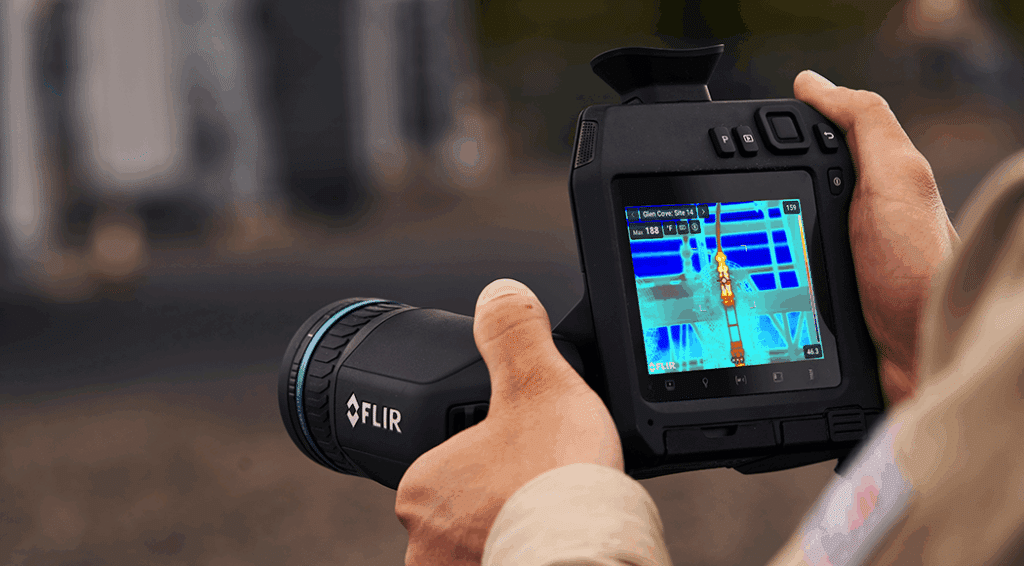
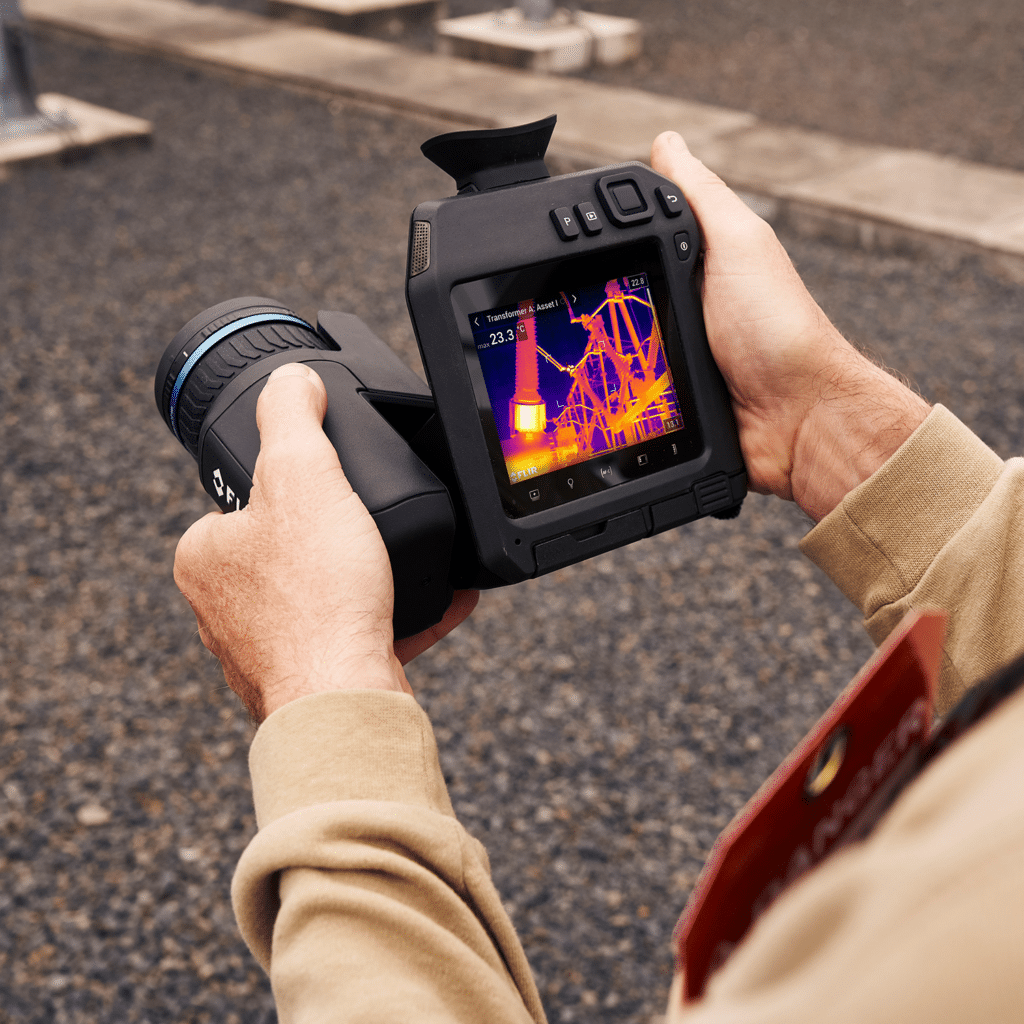
The camera’s sensor converts those infrared emissions into temperature data, which is then translated into a visual image. What you see on the screen isn’t a photo, it’s a heat map. Different temperatures are assigned different colours depending on which colour palette is active. The classic palette shows cooler areas in blue or purple and hotter areas in yellow, orange, and white. IR palettes represent temperature scales. You can adjust these scales until you find the true origin of the problem. When your scale is too low, the image would be “white washed”. If the scale is too high, no detail will be visible.
One important distinction: a thermal camera cannot see through walls or solid objects. It detects surface temperature. If heat is radiating through a wall because of a moisture problem or a missing insulation batt, the thermal camera picks that up, but only because the surface temperature has changed, not because it’s seeing inside.
Every object above absolute zero (-273.15°C) emits infrared radiation. The amount it emits is governed by the Stefan-Boltzmann law:
WRB = εσT⁴
Radiated energy is proportional to the fourth power of an object’s absolute temperature. The practical consequence: if absolute temperature doubles, radiated energy increases sixteenfold. Small things get hot fast, in radiation terms, and small setup errors produce large measurement errors. This is why correct camera configuration matters as much as the camera itself.
Detector sensitivity sets a practical floor. Even the best thermal cameras measure down to around -50°C, not absolute zero.
How Infrared Imaging Detects Problems Before They Become Failures
The real value of a thermal camera in an industrial setting isn’t finding things that are already broken. It’s catching the things that are about to break.
Most common mechanical and electrical failures have a thermal signature weeks or months before they cause downtime. A bearing running with inadequate lubrication generates friction, which becomes heat. An electrical connection that’s begun to corrode increases resistance, which becomes heat. A motor drawing more current than it should because of winding insulation breakdown, heat again.
Picture a manufacturing plant running a continuous production line. During a routine thermal walkthrough, an infrared inspection of the motor driving a conveyor belt shows an asymmetric hot spot on the drive end bearing, 18°C above the reference temperature on the same motor’s non-drive end. The motor shows no audible change, vibration readings are borderline, and there’s no visible sign of anything wrong. But the thermal image flags it clearly. Maintenance schedules an intervention during the next planned downtime window, replaces the bearing, and avoids what would have been an unplanned line stoppage.
That’s what a thermal camera is actually for. Yellotec’s condition monitoring service is built around this kind of proactive inspection, matching the right thermal imaging tool to the application so that findings translate into decisions, not just reports.
What Detector Technology Is Inside The Camera
Three detector types are used in modern thermal imaging, and the choice drives both price and capability.
Microbolometers are uncooled detectors, typically built on Vanadium Oxide (VOx) technology. Each pixel absorbs infrared radiation, which changes its electrical resistance. A Read-Out Integrated Circuit (ROIC) measures changes across thousands of pixels arranged in a detector array, and the camera converts the result into a thermal image. Microbolometers run at 9 Hz to 30 Hz, consume little power, and are the standard choice for industrial thermography, condition monitoring, and security cameras. Almost every portable thermal camera in industrial use is a microbolometer.
Photon detectors are cryogenically cooled, highly sensitive, and extremely fast (over 1000 Hz). They are used in scientific, military, and research work where speed and sensitivity justify the cost and complexity.
Superlattice (SLS) detectors are also cryogenically cooled and fast-responding, used in specialised high-performance applications.
For industrial maintenance, microbolometers are the right answer. The other two exist for problems most plants will never need to solve.
Industrial Applications(Where Thermal Cameras Earn Their Keep)
Electrical Inspection
Electrical faults are the most common starting point for thermal imaging in South African industry, and for good reason. Faulty connections, overloaded circuits, failing components, and unbalanced three-phase loads all produce heat signatures that are invisible to the eye but immediately visible with a thermal camera.
A switchgear panel inspection takes minutes with a portable thermal camera. Loose busbar connections, a breaker running hotter than its neighbours, a cable lug beginning to fail, all of it shows up on screen before it becomes a fault. In a mining operation or manufacturing facility, catching one of these before it trips a supply or starts a fire pays for the camera many times over.
Predictive Maintenance And Mechanical Monitoring
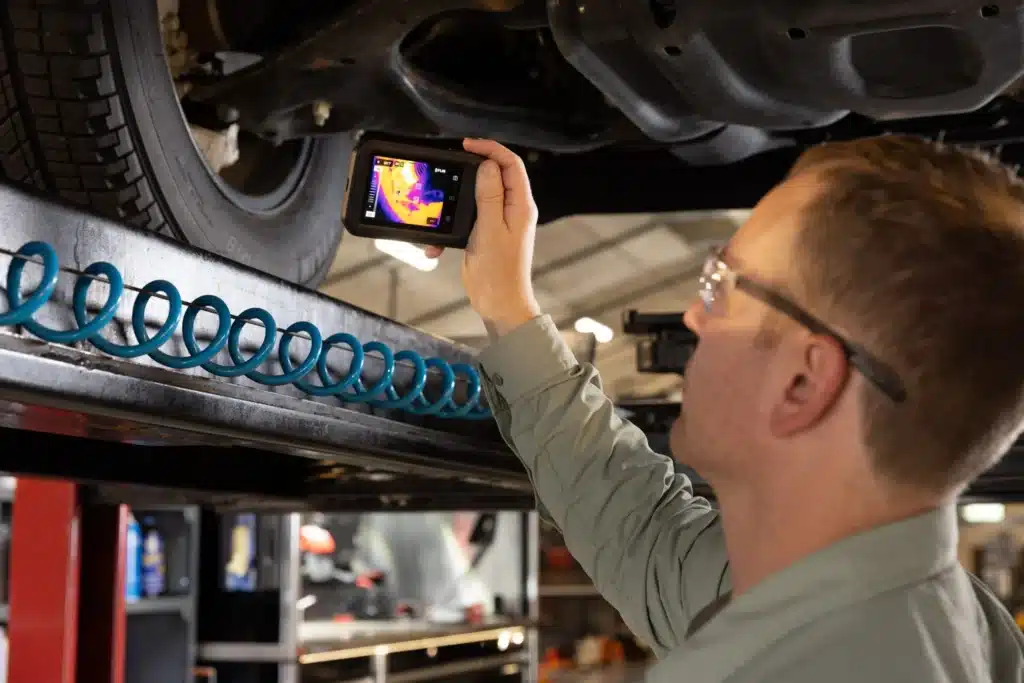
Bearings, motors, gearboxes, pumps, and belt drives all generate heat as they degrade. Thermal imaging gives maintenance teams a non-contact, non-invasive way to check equipment condition while it’s running under load, which is when problems actually show up.
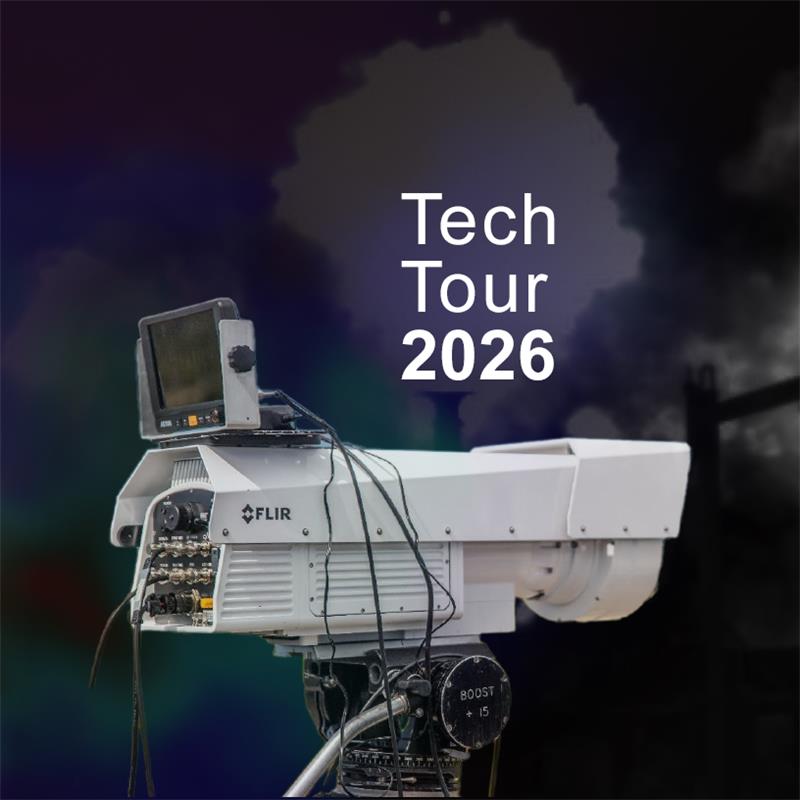
This is where fixed thermal cameras earn their place. A camera mounted above a critical conveyor drive or monitoring a transformer continuously can be configured to trigger an alarm the moment a temperature threshold is exceeded. The maintenance team gets a notification before the equipment fails, not after.
[METRIC: X% of unplanned industrial downtime is attributable to bearing and electrical failures, verify with condition monitoring industry data before publishing]
Building And Facility Surveys
Thermal cameras are used in building inspection to find insulation gaps, air leaks, moisture ingress, and underfloor heating faults. An energy audit of a large industrial facility, warehouse walls, roof insulation, HVAC ducting, can identify where heating and cooling costs are being wasted and give the maintenance team a clear remediation priority list.
In a South African context where electricity costs continue to rise, identifying thermal loss in large industrial buildings is part of operational cost management, not just facility management.
Optical Gas Imaging
A specialised category of thermal camera, optical gas imaging (OGI) cameras, is designed to detect gases that are invisible to standard thermal imagers. These cameras use a narrower spectral range tuned to absorb specific gas compounds, making methane, propane, benzene, and a range of hydrocarbons and VOCs visible as a visual plume on screen.
OGI is used in oil and gas, petrochemical, and wastewater applications where gas leak detection is a safety and compliance requirement. Fixed OGI cameras can monitor a pipeline or installation 24/7 without sending personnel into potentially hazardous zones.
Emerging Applications
Thermal imaging keeps finding new homes. Railway operators use it to detect flat spots on train wheels before they damage the track. Solar farm operators inspect PV panels for hot cells and string faults. Process automation and continuous fire-prevention monitoring are growing fast, particularly in waste handling, battery storage, and bulk material facilities where a smouldering hot spot is the early warning of a much bigger problem.
Wherever an accessible surface produces a measurable thermal signature, there’s an application waiting to be built around it.
Fixed Vs. Portable Thermal Cameras
The decision comes down to what you’re inspecting and how often.
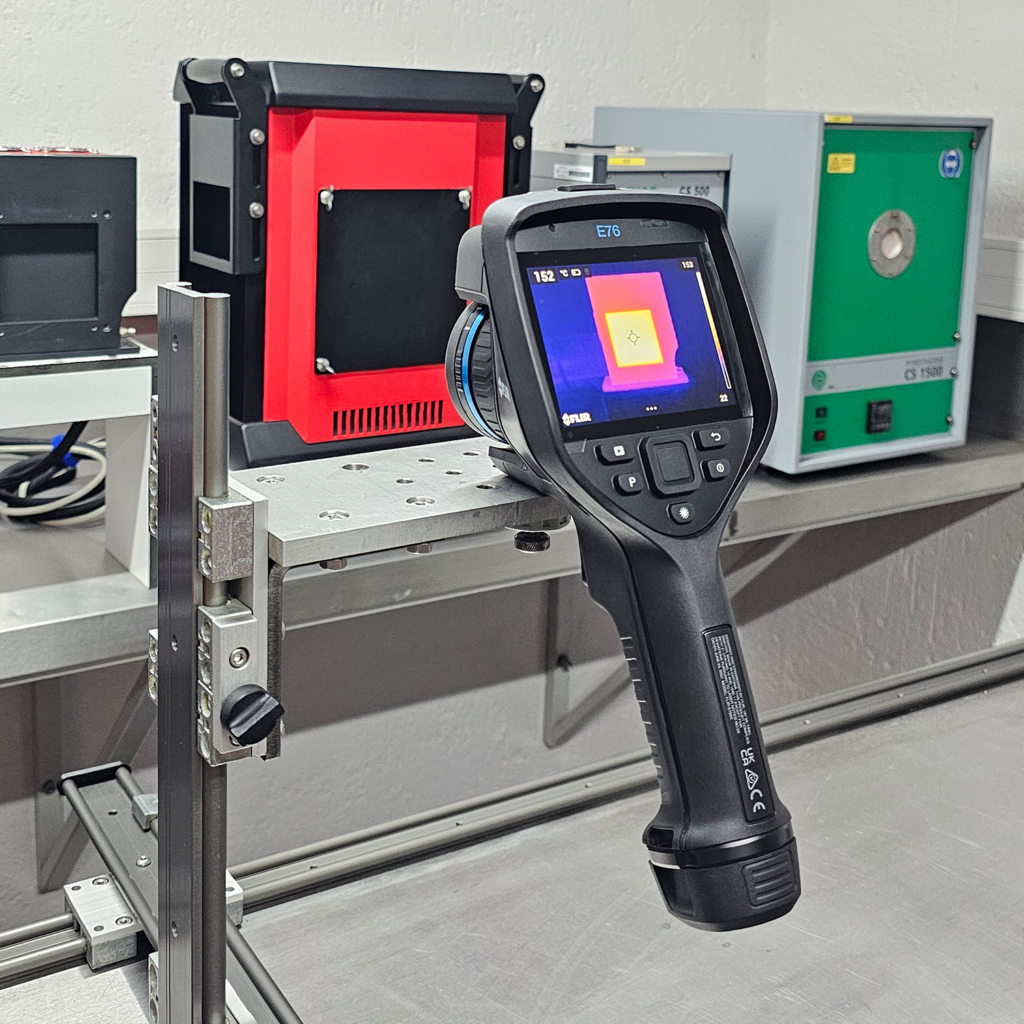
A portable thermal camera is the right tool for inspection walkthroughs, electrical panels, rotating machinery, roof surveys, building audits. It’s flexible, carried by a thermographer, and used on a scheduled or as-needed basis. Most industrial maintenance programmes start here.
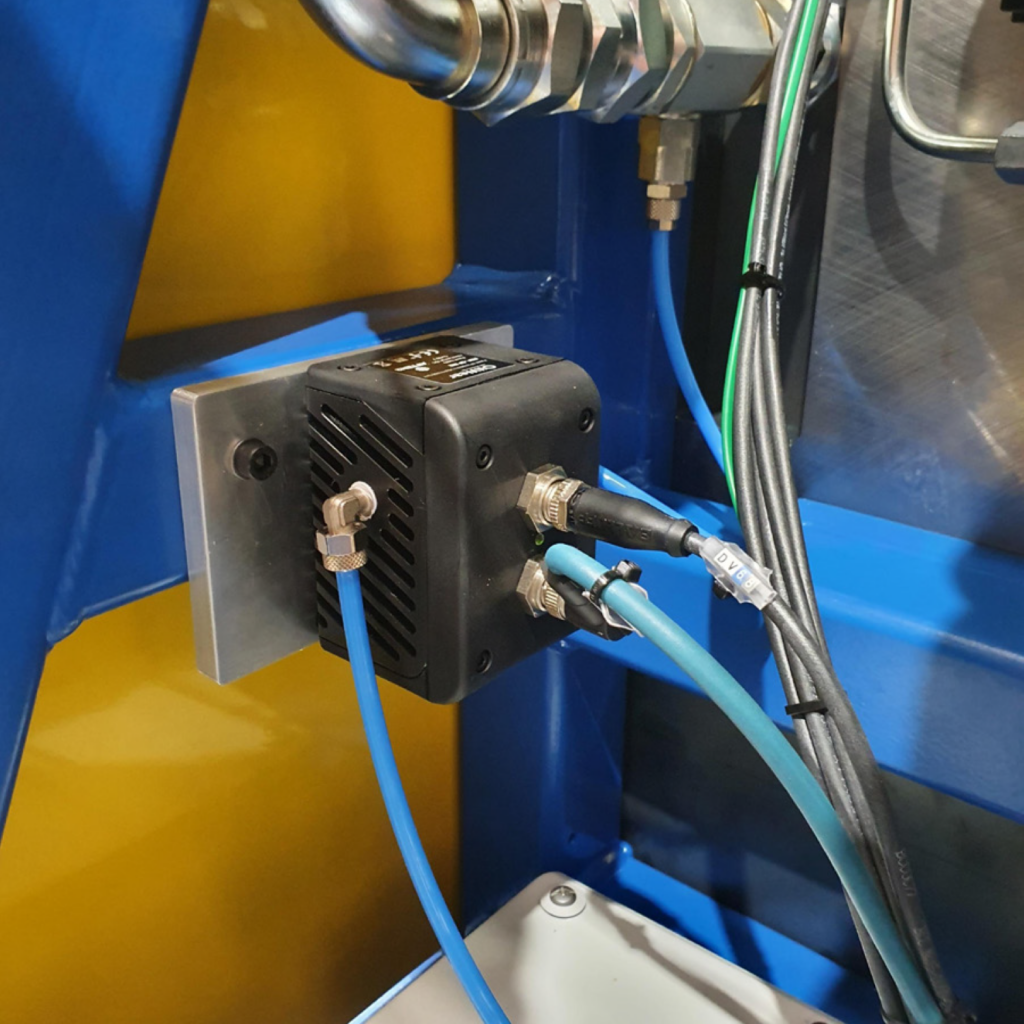
A fixed thermal camera is installed in a permanent position, monitoring a specific asset or area continuously. It doesn’t require a person present to take a reading. It can be configured to trigger alarms when temperatures exceed set thresholds and integrated into existing SCADA or building management systems. This makes sense for critical assets where a failure mid-shift would cause significant downtime or safety risk.
Some applications use both, a fixed camera on a critical drive, and a portable camera for broader inspection rounds. The right combination depends on your asset criticality, inspection frequency, and budget.
The Five Parameters That Decide Whether Your Measurement Is Right
A thermal camera doesn’t measure temperature directly. It measures infrared radiation, then calculates temperature using five inputs the thermographer has to configure correctly:
- Object emissivity — how efficiently the material radiates infrared energy. Polished metal radiates differently from painted steel. Get this wrong and the temperature reading is wrong.
- Reflected apparent temperature — the temperature of nearby objects whose radiation reflects off the target into the camera.
- Distance from camera to object — atmosphere absorbs some radiation between the target and the lens.
- Ambient temperature — the air temperature around the target.
- Atmospheric humidity — water vapour absorbs infrared radiation, particularly over longer distances.
Once these are set, the camera applies Kirchhoff’s, Planck’s, and Stefan-Boltzmann laws to calculate a temperature value for every pixel in near real time. The maths is solid. The inputs are where the errors come from, which is the practical reason training matters.
The Specs That Matter
Thermal camera specification sheets list a lot of numbers. Most buyers don’t need to understand all of them, but these six matter.
- Resolution represents the amount of information the camera can capture. More pixels = more data points. What these cameras would do with a low pixel/data point count is to blend or average the data to make it more understandable. So if your aim is to get more data and reduce blending in the image, a higher resolution would be recommended.
- Thermal sensitivity (NETD) is the smallest temperature difference the camera can detect, measured in millikelvin, lower is better. A camera with 50mK sensitivity will struggle to find subtle faults like early-stage moisture in insulation. A camera with 20mK sensitivity shows temperature differences that a less sensitive camera misses. Watch for manufacturers who quote NETD at 50°C rather than the industry-standard 30°C, it makes the number look better than it is. Choose a ranger that applies to your application. The smaller the NETD, the more data can be captured.
- Field of view (FOV) is determined by the lens. A wide-angle lens (45° or wider) suits close-up work and building surveys. A telephoto lens (12° or 6°) is for inspecting distant targets, high-voltage equipment, overhead lines, equipment you can’t safely approach while running. Some cameras take interchangeable lenses.
- Focus type: Fixed-focus cameras are designed to remain in focus within a specified working distance range, but lack flexibility. Manual focus lets the thermographer control exactly where the camera is focused. Autofocus adjusts based on contrast in the scene. For professional inspections, manual or autofocus is generally preferable.
- Temperature range is the span the camera is calibrated to measure. Most standard industrial cameras cover up to around 650°C, which handles the majority of electrical and mechanical applications. Kilns, furnaces, and high-temperature process equipment may require a camera rated higher.
- Spectral range matters primarily for gas detection. Most thermal cameras are longwave (8µm to 14µm) and suited to general industrial use. OGI cameras are midwave (3µm to 5µm) and tuned for gas detection. The wrong spectral range for gas work means you won’t see the gas, it’s not a minor spec difference.
Why Training Changes What You Get Out Of The Camera
A thermal camera is a measurement instrument. Like any measurement instrument, the output is only as reliable as the person using it.
Reading a thermal image correctly requires understanding emissivity, different materials emit infrared radiation differently, and getting a temperature reading wrong because of an emissivity setting error can mean missing a fault or incorrectly flagging healthy equipment. It requires knowing how reflected radiation affects readings, how distance affects accuracy, and how to set up the camera for the conditions you’re working in.
Someone who’s completed an Infrared Thermography CAT1A course knows why an image looks the way it does and what the temperature reading actually means. Someone handed a camera without training produces images, but not reliable findings.
Yellotec offers Infrared Thermography Category training courses from CAT1A, CATI, CAT2 and CAT3, (Sometimes called Level courses as well under the ANST) aligned with internationally recognised standards. If you’re buying a thermal camera for inspection work, the training is the part that determines whether the camera pays for itself.
Getting Started With Thermal Imaging
Thermal cameras range from compact pocket tools suited to facilities maintenance through to professional-grade systems for high-voltage electrical inspection and continuous fixed monitoring. The right starting point depends on your application, your required measurement accuracy, and whether you need portable flexibility, fixed continuous monitoring, or both.
Yellotec supplies thermal imaging products across the full range, from entry-level tools for maintenance teams to high-resolution professional cameras for certified thermographers. If you’re not sure where to start, the right conversation is about your application before it’s about specs.