

The most common reason someone doesn’t contact a thermal camera supplier in South Africa isn’t price — it’s not knowing whether the price will be in their range before they make contact. Nobody wants to sit through a sales call to find out the answer was never going to work.
This guide gives you the context you need before that conversation. It covers the price ranges you should expect across every FLIR series, what drives the differences between a R8,000 entry-level camera and a R200,000+ professional system, and what the total cost of owning a thermal camera in South Africa actually looks like over three years.
Hard prices aren’t published here for a reason: FLIR camera pricing in South Africa moves with the rand-dollar exchange rate, and any specific number published today may be meaningfully off by the time you read it. What doesn’t change is the relationship between series, the factors that push a camera up or down in price, and the total cost picture.
Why FLIR thermal camera prices in South Africa aren’t straightforward
Thermal cameras are imported goods priced in US dollars or euros at the manufacturer level. By the time a camera reaches a South African buyer, the landed cost reflects the exchange rate at the time of import, local duties, distribution margins, and whether or not the camera came through official channels.
That last point matters more than most buyers realise. FLIR cameras appear on local online marketplaces and from non-specialist resellers at prices that sometimes look significantly lower than authorised distributor pricing. Some of that difference is genuine margin competition. Some of it reflects grey-imported stock purchased in a lower-cost market and landed here without local warranty registration, without local calibration support, and sometimes without accessories that are standard in authorised channel stock.
The other variable is what’s included in the price. An authorised distributor price typically includes local warranty, access to calibration services, post-sale support, and the ability to get a qualified person involved when your camera isn’t behaving as expected. A lower price from a non-specialist reseller often includes none of those things.
All the price context in this guide reflects authorised distributor pricing through Yellotec.
FLIR price ranges by series — what each tier buys you
These are rand-denominated ranges based on current authorised distributor pricing. Treat them as orientation, not quotes — contact Yellotec for current pricing on specific models.
Cx-Series — entry-level, R8,000 to R18,000
The FLIR C5 and C3-X sit at the accessible end of the range. The C5 at 160 x 120 resolution with Wi-Fi and cloud connectivity is the more capable of the two and the better value unless budget is the only constraint.
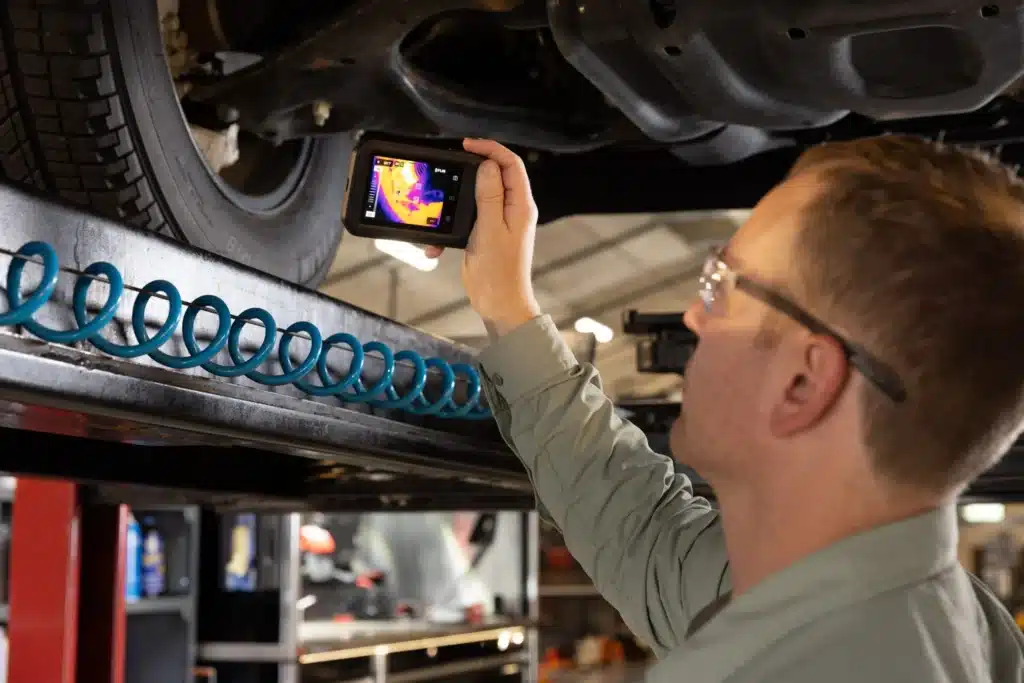
What you’re getting at this price: a tool for finding problems, not measuring them precisely. Hot fuses, air leaks, moisture behind walls, underfloor heating gaps. These cameras are not calibrated for professional thermography reports and don’t carry the measurement accuracy of higher series cameras. For facilities maintenance teams, HVAC technicians, and general inspection use, the Cx-Series is where the conversation starts.
Ex-Series — professional entry, R25,000 to R62,000
The E6 ProT is the reference point for this range. You’re buying a camera that gives you temperature data in every pixel, MSX image enhancement for sharper analysis, and measurement accuracy that supports professional inspection work.
At this price point, the camera starts earning its keep against a formal maintenance programme. An electrical panel inspection that prevents one unplanned production stoppage at a South African manufacturing facility pays for an Ex-Series camera outright. The price justification for a maintenance team at a mining operation or manufacturing plant is usually made on the first inspection cycle.
Exx-Series — advanced professional, R85,000 to R300,000
The Exx range is broader in price because it’s broader in capability. Entry Exx models offer significantly better thermal sensitivity and resolution than the Ex Pro-Series. Top Exx models approach T-Series capability with interchangeable lenses, high-resolution sensors, and full radiometric data storage in every image.
This is where organisations with formal thermography programmes, energy auditing work, or building inspection practices typically land. The price jump from Ex Pro to Exx is real, but so is the capability difference, particularly in thermal sensitivity and the ability to reanalyse raw data from images after the inspection.
T-Series — professional flagship, R190,000 to R920,000
The T-Series price range is wide because the series spans several models with meaningfully different capabilities. A T530 and a T865 are both T-Series cameras, but they’re not the same tool.
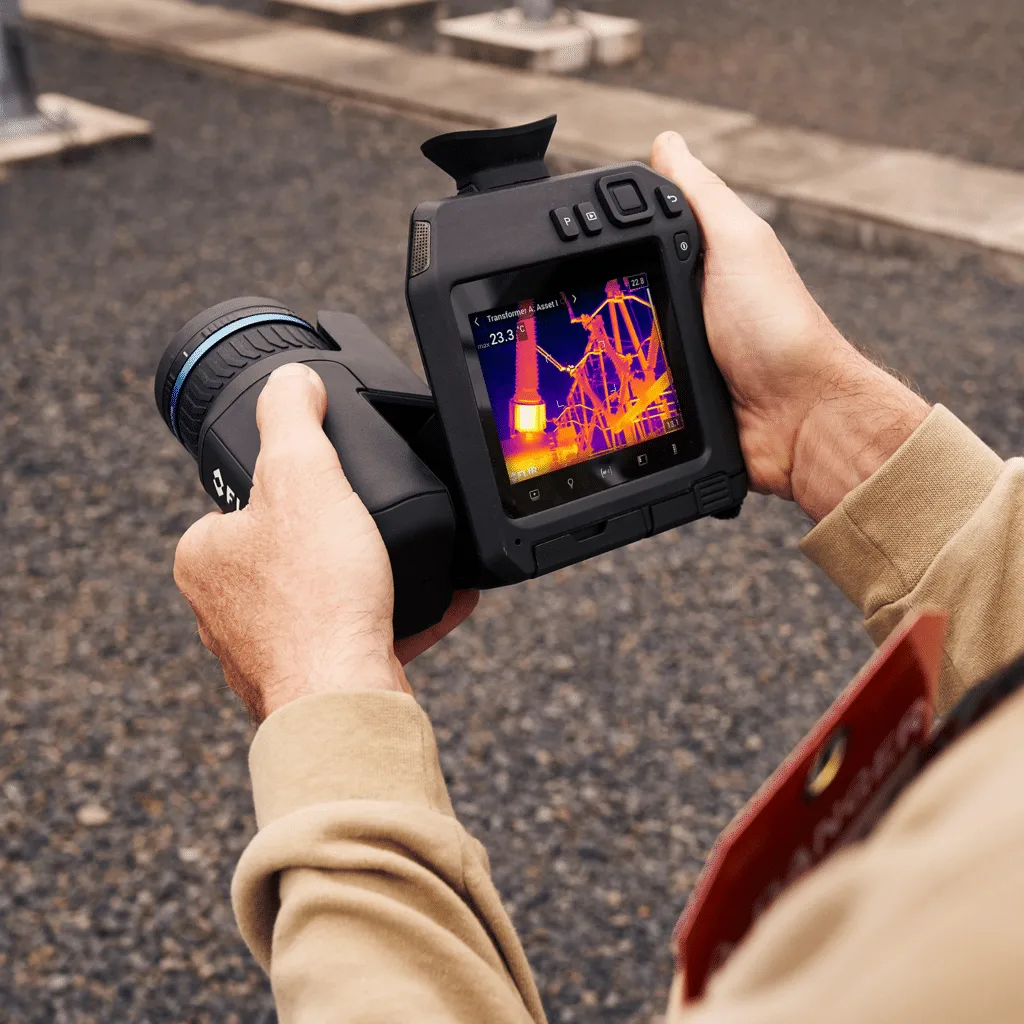
At the lower end, you’re buying the 180° rotating optical block, professional-grade sensitivity, and the ergonomics a thermographer uses through a full inspection day. At the upper end, you’re buying 640 x 480 resolution and the measurement accuracy required for utility-grade work. Both models have interchangeable lenses.
For a certified thermographer doing formal condition monitoring work — switchgear inspection, transformer assessment, predictive maintenance reporting — the T-Series is the right range.
Fixed cameras — R25,000 to R600,000+
Fixed camera pricing varies significantly based on resolution, integration capability, and whether you’re buying a compact monitoring unit like the AX8 or a smart sensor system like the A400/A500/A700 series with edge computing and IIoT integration.
The AX8 is a practical entry point for organisations that want continuous monitoring of a specific critical asset without the cost of a full inspection camera. The A400/A500/A700 series integrates into existing SCADA and HMI systems for complex multi-point monitoring applications.
The price is heavily dependant on the required solution.
OGI cameras — R300,000+
Optical gas imaging cameras occupy a specialist price tier that reflects their specialised detector technology. The GFx320, G300, and G300 PT are compliance and safety tools for organisations with gas detection obligations, not general inspection cameras.
At this price point, the buying conversation is almost always application-specific. If you’re operating in oil and gas, petrochemical, or wastewater infrastructure and have fugitive emissions monitoring requirements, the right starting point is a technical discussion with our team.
What drives the price difference between series
Five factors account for almost all of the price variation between FLIR camera models.
Resolution. A 160 x 120 sensor and a 640 x 480 sensor are both thermal cameras, but the 640 x 480 contains 16 times more data points. Higher resolution means detecting smaller temperature anomalies from further away. The resolution difference between an Ex Pro-Series and a T-Series camera is the single biggest reason for the price gap.
Thermal sensitivity (NETD). This is the smallest temperature difference the camera can reliably detect. A camera with 50mK NETD struggles to find early-stage moisture in insulation or a bearing that’s 3°C above its baseline. A camera with 20mK NETD catches those findings comfortably. Better sensitivity costs more because the detector technology is more precise.
Temperature range. Most standard inspection cameras measure up to around 650°C, which covers electrical and mechanical inspection work. Cameras rated for high-temperature applications — kilns, furnaces, smelting operations — require extended range sensors that add cost. If your application doesn’t involve high-temperature targets, you’re paying for range you don’t need.
Lens options. Fixed-lens cameras cost less than cameras with interchangeable lens systems. A telephoto lens for long-distance electrical inspection is essential for utility work where you can’t safely approach energised equipment. If your inspection work is consistently close-range, a fixed wide-angle lens is the right choice and avoids the lens system premium.
Software and data management. Entry-level cameras save radiometric JPEGs you review manually. Higher-tier cameras store full radiometric data, integrate with FLIR Tools software for detailed post-inspection analysis, and on the fixed camera side, integrate with SCADA and IIoT platforms. The software capability is embedded in the camera price and is meaningful for organisations running formal inspection programmes.
Total cost of ownership — what the camera actually costs over three years
Purchase price is the most visible number, but it’s not the whole picture. Here’s what a three-year cost model looks like for a professional inspection camera in South Africa.
| Cost item | Entry-level (Cx/Ex) | Professional (Exx/T-Series) |
| Camera purchase | R8,000 to R18,000 | R85,000 to R300,000+ |
| Accessories (carry case, extra battery, lens) | R2,000 to R8,000 | R5,000 to R20,000+ |
| Software licence (if applicable) | Included or low-cost | Included or subscription-based |
The training line is where most buyers miscalculate. A technician using an Ex-Series camera without thermography training produces images they can’t reliably interpret. The training cost is part of the camera investment, not a separate decision. In many cases, the total outlay for an Ex-Series camera plus CAT1A training is close to a T-Series camera purchased by someone who already holds certification.
Calibration is the other line item worth noting. A thermal camera used for professional inspection work should be calibrated annually. Skipping calibration to save cost is a false economy if the camera is being used to make maintenance decisions on critical equipment. Yellotec provides calibration services locally, which means the cost and logistics are manageable from a South African maintenance programme.
Why the cheapest FLIR price isn’t always the lowest cost
A grey-imported FLIR camera bought at a 20% discount to authorised channel pricing can look attractive in a capex justification. The problems show up later.
If the camera develops a fault and the warranty isn’t registered to South Africa, the repair or replacement cost comes out of your maintenance budget. If annual calibration isn’t available locally for that camera variant, your inspection findings may not be defensible in a maintenance audit. If you need application support and the reseller doesn’t have technical capability, you’re on your own.
Organisations with formal maintenance programmes buy through authorised distributors not in spite of the price, but because the total cost over three years is often lower.
How to get an accurate quote from Yellotec
A quote request is most useful when you come prepared with four things: what you’re inspecting, at what distance, how often, and what you’ll do with the findings.
“Inspecting electrical switchgear panels at a manufacturing plant, panels up to five metres away, monthly inspection rounds, findings go into a formal maintenance report” gives our team enough to recommend the right series and model, confirm current pricing, and advise on training requirements. “I need a thermal camera” starts a longer conversation.
You can request a quote directly through Yellotec’s product pages or contact their team for a pre-purchase consultation. If you’re not sure where in the range you should be looking, that conversation is worth having before you commit to a purchase.