

View Quote 0
Tips On Designing Your Lab Space
Oil Lab Series

Tips On Designing Your Lab Space

Oil Lab Series Article 3 – Tips On Designing Your Lab Space.

Related Articles

Improving Gearbox Test Consistency with Atten[2] OilWear Sensor
Reliable gearbox validation with accurate oil cleanliness monitoring in bubbly conditions. This case study shows...
Case Studies Articles
Atten2 webinar Mining Crusher Thumbnail
Webinar // Mining 4.0: Maximizing Uptime in Critical Machinery with Advanced Monitoring
Join us for an insightful webinar focused on Mining 4.0 and how advanced condition monitoring is transforming...
Webinar Articles

Related Articles

Oil Lab Series
Everything you need to know to build and run your own on-site oil analysis laboratory.
Oil Lab Series
Why you should think about having an On-Site Lab
Oil Lab Series Article 1 - Reasons to Invest in an On-Site Oil Analysis Lab
Oil Lab Series
Oil Lab Series 3

Previously on the Oil Lab Series we looked at the investment needed to set up and run your own oil analysis lab. In this article we look at some factors that you need to keep in mind when designing your lab space.

The design of your lab is mostly dependant on your oil analysis requirements, but also other factors such as available physical space, work flow efficiency and, most importantly, safety.

JAN20 OilLabS SocialMedia Post3

Oil Analysis Requirements:
Your oil analysis needs will determine the type of tests you need to run on your samples, as well as the instruments required to run those tests. We will be covering tests and instruments in greater detail in the next article of the Oil Lab Series.

Physical Space:
To set up a lab, you need to ensure that you have the physical space that:

  • has a layout assisting efficient work flow;
  • has a carefully controlled climate, including temperature and humidity;
  • take steps to minimise airborne contaminants;
  • has adequate ventilation, particularly if noxious chemicals will be used;
  • adequate workspace and hook-up for air, water and power, including room for expansion if planned; and
  • enough storage to be able to store samples for a minimum of three months for retest or lab analysis.

Safety:
Running a lab requires the use of chemicals and chemical reactions, and so it is always important to keep the health and safety of you and your fellow workers a number one priority. Make all essential safety equipment available, including eye protection, gloves and MSDS sheets. Ensure that all staff have been trained on safety procedures.

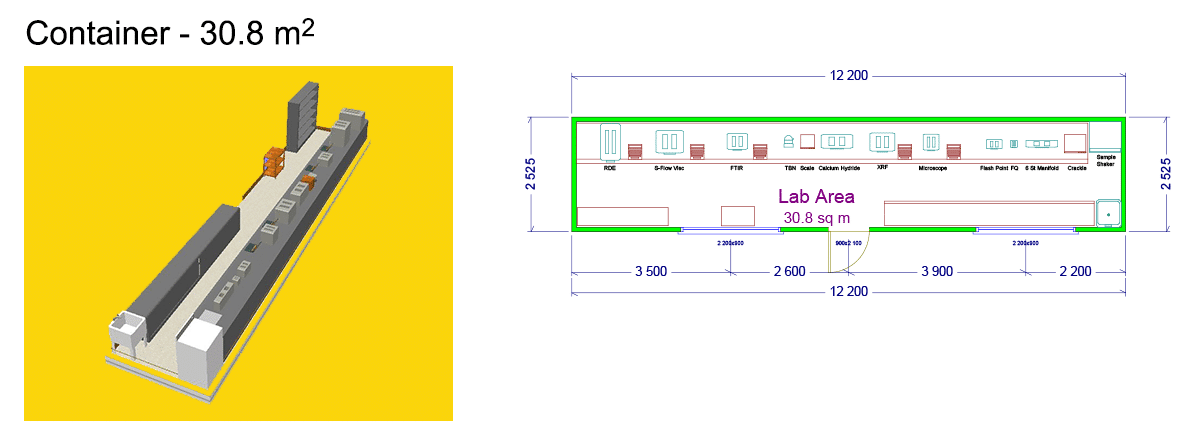
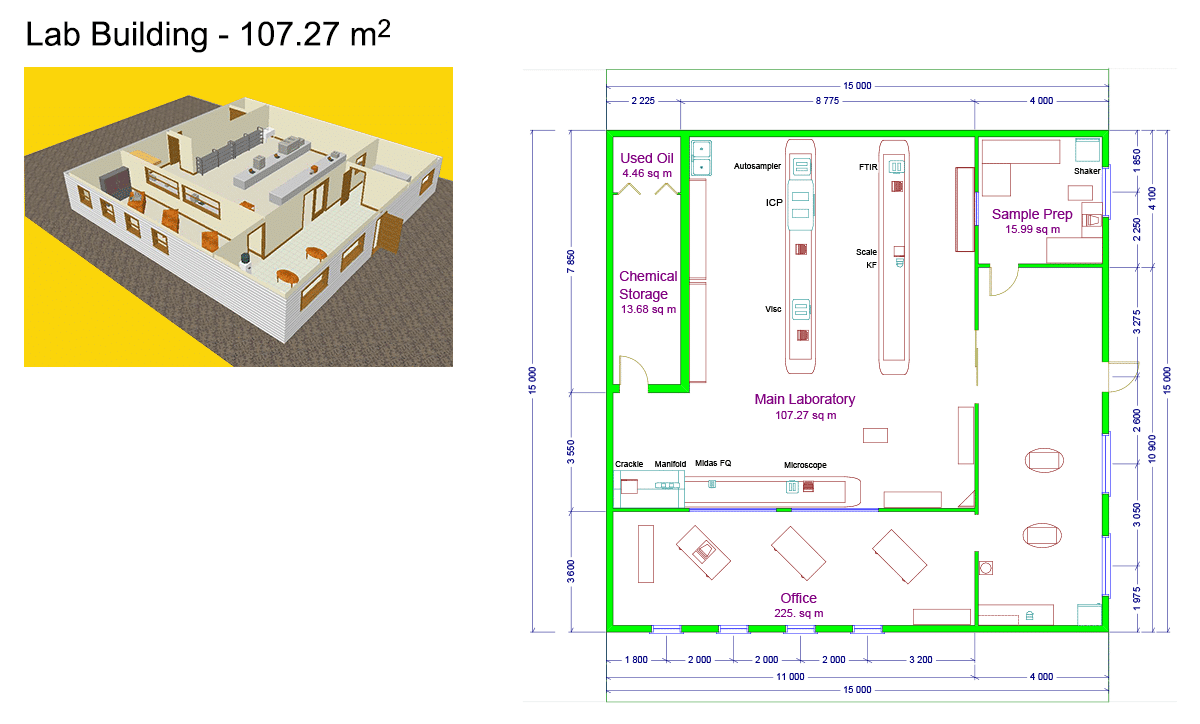
If you do not have the space and capacity yet to build and run a full-scale lab, you can easily start with a smaller version and expand as and when you are able to. The below schematic illustrates how you can start with a smaller lab layout inside a container, and how it can grow and expand into a full-scale operation with your own building.
Related Articles

How a single seal failure could cost you Millions
Oil Lab Series Article 5 - Read how an on-site lab avoided a big failure
Oil Lab Series
3 Phased Approach: A quick guide to Oil Analysis instruments and tests
Previously in the Oil Lab Series we looked at tips to design your lab, specifically...
Oil Lab Series
Is it worth the investment of an Oil Analysis Lab?
Oil Lab Series Article 2 - Investment Scenario
Oil Lab Series
Why you should think about having an On-Site Lab
Oil Lab Series Article 1 - Reasons to Invest in an On-Site Oil Analysis Lab
Oil Lab Series

Featured Links

Currently no products have been added to your quote.
FLIR A40_IRT
FLIR A40 Smart Sensor Camera
Discountined Products FEATURE IMAGE
FLIR A310 (Discontinued)
Discountined Products FEATURE IMAGE
FLIR A315 (Discontinued)
Vibrex
VIBREX
Spectro 2 card
Spectrum Two FTIR
FLIR G609 image
FLIR G609
FLIR K1
New
FLIR K1
Privacy Overview
Yellotec logo in black

This website uses cookies so that we can provide you with the best user experience possible. Cookie information is stored in your browser and performs functions such as recognising you when you return to our website and helping our team to understand which sections of the website you find most interesting and useful.

Strictly Necessary Cookies

Strictly Necessary Cookie should be enabled at all times so that we can save your preferences for cookie settings.